Advanced Data Recovery
Recovering the Unrecoverable
1. Hard Drives
Hard disk drives are vulnerable to electronic failure, a sudden power failure, physical shock, contamination of the drive’s internal enclosure, wear and tear, corrosion or poorly manufactured platters and heads. Increasingly, we are seeing how poor manufacturing and cheaper materials are making the data recovery process more challenging.
Data Clinic technicians are constantly developing new skills and processes to deal with problematic hard disk drive recoveries.
Our standard data recovery processes for mechanical faults usually involve changing the heads, however, in many cases we are seeing contamination to the platter surfaces. Previously, this would have meant we were unable to recover the data; however, research and development has enabled us to provide an Advanced Data Recovery service that removes and cleans the platters.
Our free fault diagnosis will tell us if the fault on your hard drive is logical or mechanical. We then send you the Evaluation Report that will tell you the exact costs and you can choose whether to go-ahead with the service or not. At this stage we can only see the top platter of your drive in any detail. If we see contamination to the top platter, then you will be offered our Advanced Data Recovery Service. The cost of the service depends on the number of platters in your drive, whether you need parts and whether we’re successful or not.
If you wish to go ahead, we will need to conduct an in-depth examination of all the platters in your drive to ascertain whether platter cleaning and head replacement is likely to lead to success. At this point we will let you know how likely success is.
If data recovery is deemed possible, then we will remove and clean the platters. The tiniest dust particles or even a fingerprint on a platter will prevent the drive from reading/writing data. If the platters are contaminated, the heads will also be contaminated. We use ultra- high magnification stereo microscope and acetone medical grade cleaning swabs to remove particles from hard drive heads. Or, we may have to conduct a head change. New heads can be expensive as we have to precisely match the new parts to the precise model/batch no. of your hard drive. We may have to purchase new heads from China or the USA, the rarer the drive, the more expensive the heads.
I have included a brief description of a hard disk drive to give you a good understanding of how precise our work has to be:
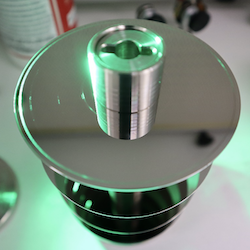
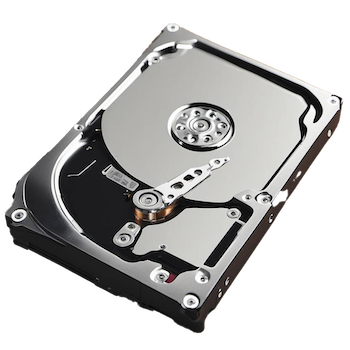
“A typical HDD design consists of a spindle that holds flat circular disks, called platters, which hold the recorded data on both sides. The platters are made from a non-magnetic material, usually aluminium alloy, glass or ceramic and are mirror smooth. They are coated with a shallow layer of magnetic material typically 10–20 nanometre in depth, with an outer layer of carbon for protection. Information is written to and read from the platter as it rotates past the read/write heads at speeds varying from 4,200 to 15,000 rpm. The heads are positioned to float on a current of air produced by the fast rotation of the disks. The heads sit as close as 3 nanometres from the magnetic surface. The read/write heads detect and modify the magnetization of the material passing immediately under it. The arm that holds the heads can move from the centre to the edge and back up to 50 times per second.”
The cost of Advanced Data Recovery is as follows:
Stage 1 – Advanced Diagnosis to ascertain the condition of the platters and decide whether ADR is likely to be successful – £95.00 + VAT
Stage 2 – Platter Cleaning and head change @ £95 + VAT per platter surface + parts cost
Stage 3 – Data Recovery – we send you a File List of all the data that we have successfully recovered, you accept the file list and the data is copied to a new hard drive = £395 + VAT + a hard drive of your choice.
2. Mobile Phones & Tablets
Data Clinic have invested significant research into the repair of handsets and diagnostic techniques to analyse faults and regain access to phone data. With encryption and security on mobile devices becoming ever more complex, this is an area of continuous learning and development.
Chip-Off Procedure
Data Clinic has specialist equipment to remove eMMC (embedded Multi Media Controller) flash storage chips in the safest possible way. Instead of the conventional method of blasting the chip with heat and lifting it, which frequently causes significant damage, the chip is removed by “digging” it out from the underside of the board thus allowing the chip to be released safely. This method carries a far reduced risk of damage to the chip, so often caused by heat. The chip is then”re-balled’ and cleansed with specialist micro soldering applications. The data can then be extracted using a specialist chip reader and the raw data decoded.
 Short Circuits
A common issue with mobile devices is a short circuit, and a short circuit to ground on any line of a logic board can render the device useless. We have identified numerous methods for determining whether a line has been shorted and where the source is. A common diagnostic tool used is schematic software specifically designed for this type of analysis. We can determine which of the hundreds of components on the board have been affected. When the appropriate schematics aren’t available, we have the capability, gained through experience, to identify the source of the fault through analysis of certain patterns and traits, for example, using Microscopic inspection, observing power consumption and testing for any other factors such as necessary cleaning. Data Clinic use micro soldering techniques for a variety of purposes, for example, replacing the FPC (Flexible Printed Cable) connectors of logic boards, replacing failed BGA chips, the chips that deal with power, display, USB connectivity and charging. For these types of recovery, it is essential to use a special type of flux to bring down the melting point of the solder and have an incredibly steady hand with a heat gun.
Physical Damage
Physical damage is the number one problem we see with mobile phone recoveries, for example, a broken line, where the connection should travel between the two points; but, due to wear and tear has become disconnected. We use hair-thin jumper wire to re-establish and where necessary, strengthen broken connections. A process of UV curing is then added, a solder mask is applied to our created joint and then solidified beneath a UV lamp, thus ensuring a sturdy connection that shouldn’t break again. Water Damaged phones are also dealt with as above. Water damage can ‘set in’ and leave serious corrosion that spreads. Putting a phone in rice always makes a board a lot harder to clean properly. We use industry standard ultrasonic baths that are designed with specialist PCB cleaner fluid to remove any traces of contamination.
For further information visit our Phone data recovery page.
RIPA Act Part 3 Section 49
We rebuild and reconstruct broken phones back to a working condition so that the owners may be charged under Section 49 of the RIPA (3) Act, see here for further information. Click here for further information about our phone rebuild services for police forces.
3. RAID and Complex Multiple Disk Systems
Multi disk systems such as home and business servers running RAID configurations can present complex and unique problems to digital forensic examiners. We can help piece the data back together from across multiple sources – you can read more on our RAID data recovery page.
Data Clinic Business Customers Include



Our Latest Google Reviews
Data Clinic Locations
We have many data recovery locations across the UK. You are welcome to drop off but will need to book an appointment first.
Alternatively use our Free Collection service that picks up from ANY UK address.
New London House, EC3V 9LJ
The Mount, Belfast, BT6 8DD
11, St. Paul’s Square, Birmingham, B3 1RB
Castlemead, Bristol, BS1 3AG
20 – 23 Woodside Place, Glasgow, G3 7QF
Building 3, Gelderd Road, Leeds, LS12 6LN
Horton House, Exchange Street East, Liverpool, L2 3PF
The Pavilions, Bridge Hall Lane, Bury, BL9 7NX
Rotterdam House, 116 Quayside, NE1 3DY
Victory House, 400 Pavilion Drive, NN4 7PA
The Balance, 2 Pinfold Street, Sheffield S1 2GU
Basepoint, Andersons Road, Southampton, SO14 5FE